
KEY TAKEAWAY
The transition of Mombasa port delays from local news to global maritime reporting signals a shift in risk profile, requiring exporters to adopt structured communication to prevent buyers from pricing in corridor unreliability.
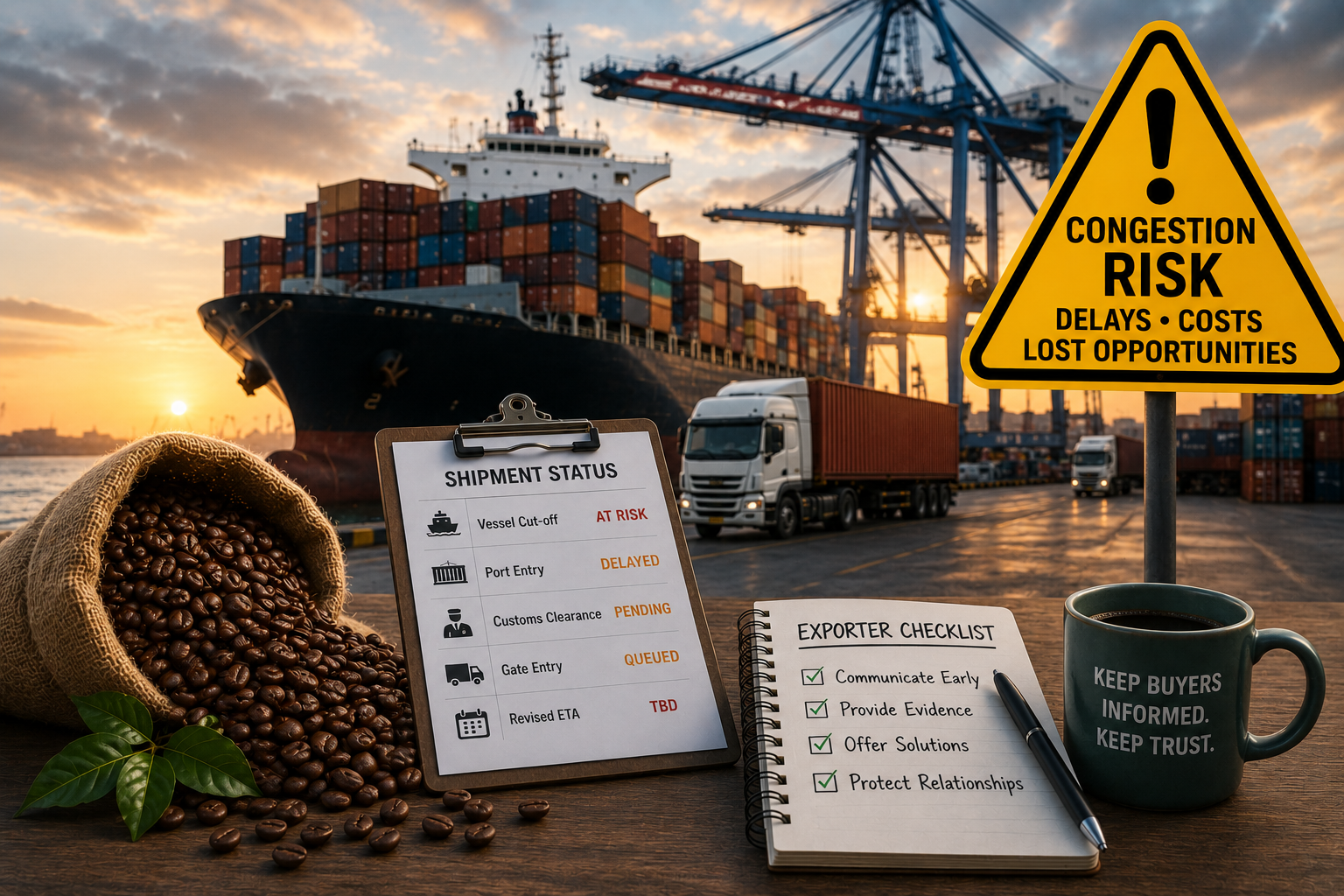
The transition of Mombasa port delays from local news to global maritime reporting signals a shift in risk profile, requiring exporters to adopt structured communication to prevent buyers from pricing in corridor unreliability.
Hellenic Shipping News has elevated the Mombasa coffee export disruption from a domestic logistical challenge to a global maritime trade issue. This shift in visibility forces a change in how buyers, insurers, and financiers perceive the reliability of the East African coffee corridor. Exporters must now manage not just the physical movement of goods, but the reputational risk that follows global media scrutiny.
Global
Media exposure level
High
Export truck queue intensity
Rising
Logistics premium risk
90 Days
Resilience planning window
The visibility of the disruption has fundamentally changed the commercial landscape for Kenyan exporters.
Strategic impact
Failure to manage the narrative leads to direct commercial penalties.
Long-form analysis
The publication of Mombasa port disruption in global maritime trade press marks a critical turning point. While local actors have long managed congestion, the entry of international trade media means that global merchants and roasters are now receiving automated alerts about the reliability of the East African coffee corridor.
This is no longer a domestic logistics problem; it is a global market-access issue. Buyers are now adjusting their risk assessments, which can lead to systemic changes in how Kenyan coffee is priced and contracted.
Exporters must move away from informal updates and embrace a structured communication rhythm. Silence during periods of disruption is often interpreted by buyers as a lack of control, which is more damaging than the delay itself.
By providing consistent, evidence-based status reports, exporters can maintain trust even when physical movement is stalled.
Exporters often fall into the trap of being operationally innocent but commercially exposed. Even if the bottleneck is caused by customs-system instability or port-entry restrictions, the buyer ultimately holds the exporter accountable for the missed delivery.
To escape this, exporters must document the external nature of the disruption while showing exactly how they are navigating the system. This transforms the exporter from a passive victim of the corridor into a managed-risk partner.
Over the next 30 to 90 days, the focus must be on institutionalizing the response. This involves creating standard playbooks that can be triggered the moment port congestion or customs downtime occurs.
By systematically capturing delay data, sector associations can also provide the evidence base needed to advocate for corridor reforms, turning local operational pain into a catalyst for systemic improvement.