
KEY TAKEAWAY
Exporters must stop treating EU compliance as a technical burden and start using it as a commercial differentiator to secure premium market access while diversifying into emerging regions.
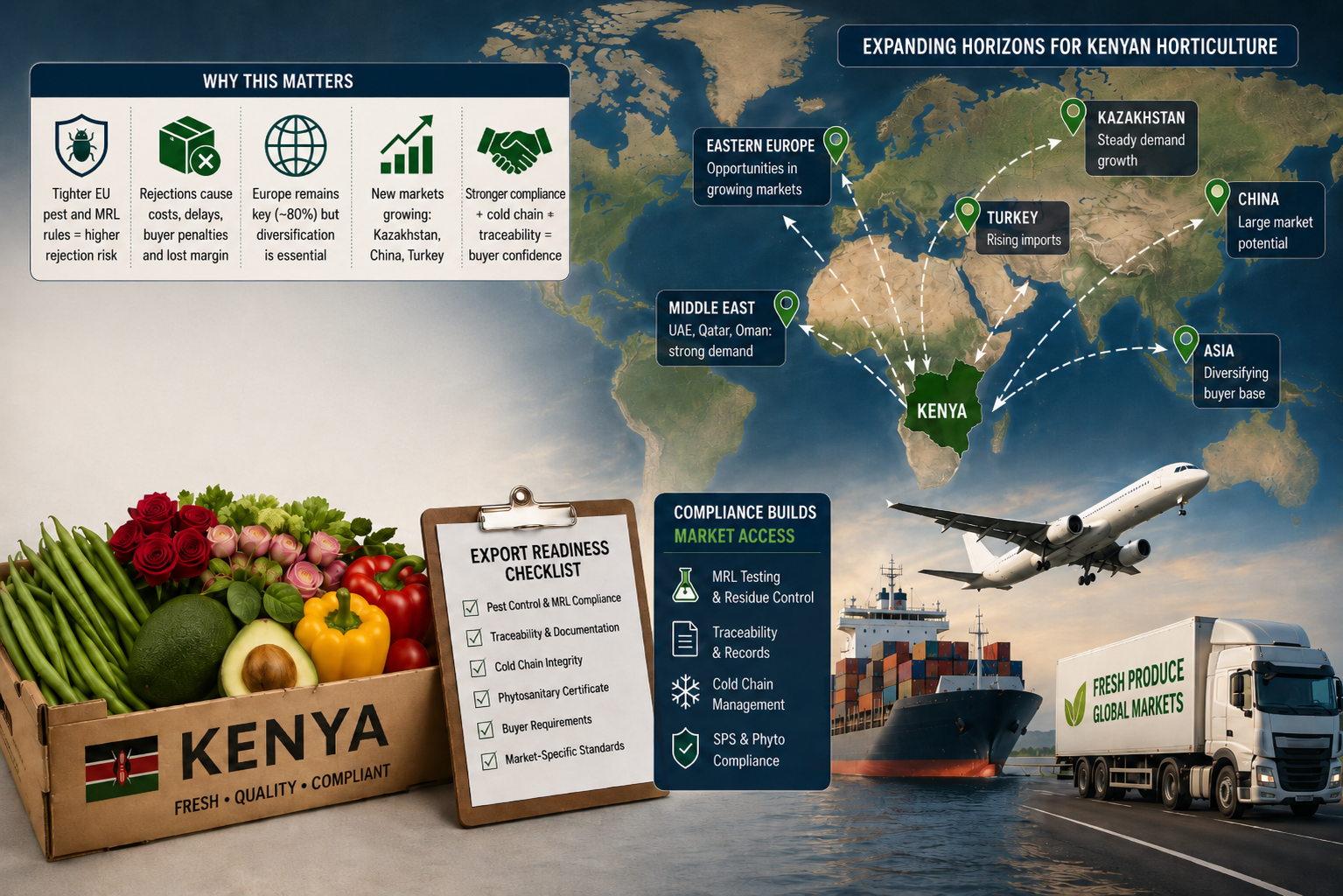
Exporters must stop treating EU compliance as a technical burden and start using it as a commercial differentiator to secure premium market access while diversifying into emerging regions.
Kenyan horticulture exporters are increasingly looking beyond the European Union toward Asia, the Middle East, and Eastern Europe as regulatory hurdles intensify. While Europe remains the premium anchor market, the rising cost of rejection risk is necessitating a more sophisticated approach to market diversification. This transition requires moving beyond simple trade promotion to a model built on rigorous SPS controls, MRL discipline, and cold-chain reliability.
80%
Share of exports currently tied to the EU market
2020-2023
Growth period for shipments to China, Turkey, and Kazakhstan
Variable
Commercial penalty cost per rejected consignment
30-90 Days
Window for implementing new risk-mitigation registers
Diversification is no longer an escape route from EU rules, but a portfolio-balancing strategy.
The commercial logic
Moving into new markets without addressing underlying compliance gaps creates significant exposure.
Long-form analysis
The operating model for Kenyan exporters must shift from volume-chasing to value-protection. Exporters need to segment their market portfolio by compliance intensity, rejection risk, and landed-cost economics.
A shipment that is commercially viable for the Netherlands may not be the right operational fit for China or the UAE. Route design, certification evidence, and buyer communication must be tailored to the specific requirements of the destination.
To succeed in both established and new markets, exporters must master four core pillars of trade facilitation. These elements determine whether a product reaches the shelf or is intercepted at the border.
The commercial pivot is to treat rejection risk as a board-level cost and diversification as a structured risk-management portfolio. Exporters should calculate rejection-adjusted margins rather than relying solely on FOB or CIF pricing.
Buyers should receive compliance evidence before shipment, not after an alert. This proactive approach turns compliance discipline into a competitive advantage that justifies premium pricing.
The sector must move quickly to build an EU Rejection Risk Register. This register should categorize products by buyer, destination, and specific pest or MRL issues, allowing for targeted corrective actions.
Finally, exporters should coordinate with AFA, KEPHIS, and logistics providers to ensure that market-diversification efforts are backed by the necessary certification financing and residue-testing infrastructure.
TFN provides the tools and diagnostics to help you turn regulatory pressure into a structured commercial response.