Kenya Tea's Margin Trap: How a New Levy and Closed Corridors Put Premium Grades at Risk
1 July 2026
Kenya’s tea sector is facing a growing margin trap. With 1.7 million kg of Sudan-bound BP1 tea reportedly still stranded in Mombasa and Sudan and Iran corridors constrained, a new value-based levy is adding cost pressure to premium grades just as reduced Kenyan and Sri Lankan supply could have supported higher prices. This analysis examines what the combined shocks could mean for exporters, factories, growers and Kenya’s ability to convert tighter global supply into stronger returns.
By Beryl Njeri OlubandwaTrade Facilitation Director
Share:
inXf
KEY TAKEAWAY
Kenya's tea sector is struggling to convert tighter global supply into higher returns due to stranded, destination-specific stock and a value-based levy that penalizes premium grades. Success now depends on lot-level commercial control rather than broad market assumptions.
Introduction
Kenya’s tea sector is facing a growing margin trap as two interacting shocks threaten to undermine the benefits of a tighter global supply market. With over 1.7 million kg of Sudan-bound BP1 tea stranded in Mombasa and new value-based levies increasing costs, exporters are finding that higher international prices are being diluted by logistical and policy-related friction. This analysis examines how these combined pressures are forcing a shift in how tea businesses must manage their stock, routes, and buyer relationships.
By the numbers
1.7M kg
Stranded Sudan-bound BP1 tea
0.8%
Value-based tea levy rate
50M kg
Estimated Kenya production decline
25-30%
Projected Sri Lanka output drop
1
The Commercial Friction
The current market environment is creating structural barriers that prevent premium tea from reaching its full potential.
Why it matters
✓Value-based levies create a countercyclical burden on high-quality grades.
✓Destination-specific packaging limits the fungibility of stranded inventory.
✓Buyer substitution to regional origins is accelerating due to perceived price volatility.
2
Operational Risks
Exporters face multiple layers of risk that can erode margins if not managed with precision.
!Quality deterioration of long-stored tea in Mombasa warehouses.
!Working capital depletion due to extended cash-conversion cycles.
!Loss of buyer confidence in Kenya as a reliable, predictable supply source.
!Inability to re-route stock without incurring significant repackaging costs.
!Margin compression resulting from the interaction between levy costs and buyer discounts.
Infographic
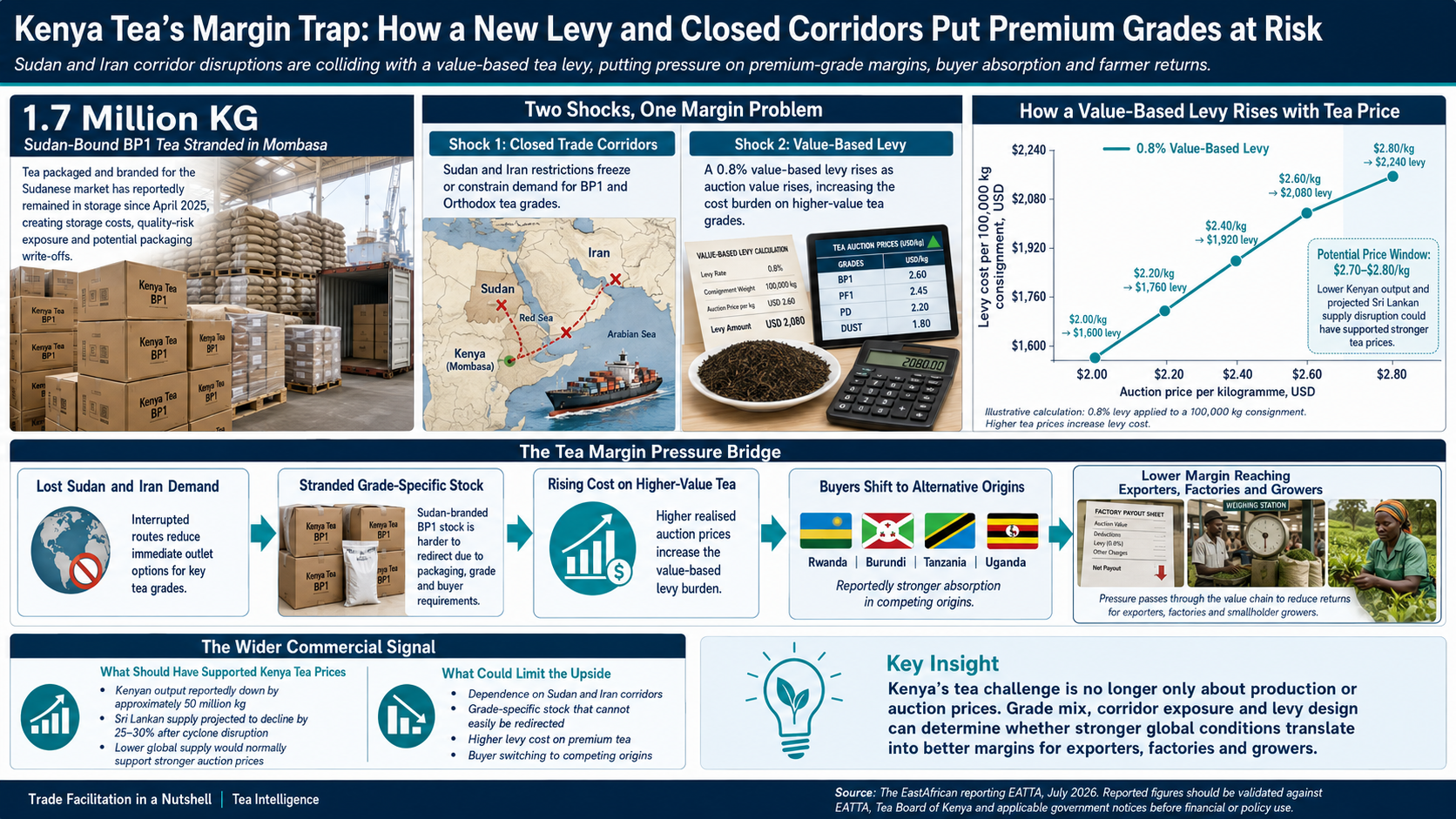
This visualization illustrates how the 0.8% value-based levy scales with auction prices, creating a growing cost burden on premium Kenyan tea consignments.
Long-form analysis
Navigating the Margin Trap: From Country-Level Strategy to Lot-Level Control
The Commercial Context
The headline figure is operationally significant: EATTA Managing Director George Omuga told The EastAfrican that more than 1.7 million kg of Sudan-destined tea bought in April 2025 remained branded and stored in Mombasa more than a year after the Sudanese import ban. The direct cost is warehouse storage. The more important cost is that tea packaged for a defined destination is not a fully fungible asset. The pack format, label language, buyer specification, grade profile, route economics and payment arrangements can all be market-specific.
Sudan was particularly important for BP1, while Iran has historically been a major buyer of Kenya’s Orthodox tea. When those markets become inaccessible, affected tea cannot simply be shifted onto another route at the same price and in the same format. The exporter may need to relabel, repackage, discount, find a different buyer, accept slower cash conversion or hold stock longer while quality and market value decline.
The levy adds a second source of friction. A quantity-based levy creates a fixed charge per kilogramme. A value-based levy increases with the sale price. This creates an undesirable countercyclical effect for premium grades: the better the price, the higher the levy burden. EATTA and market participants are urging a quantum, or per-kilo, basis on the ground that it is the commonly used model and avoids making higher-value tea disproportionately less competitive.
How the Pressure Has Built Up
The commercial pressure has accumulated through a sequence of linked events rather than a single disruption. Sudan’s ban closed an efficient, nearby market. The Iran blockade constrained an important buyer base for Orthodox tea. Then the May 2026 levy introduced a value-related cost at a time when global supply fundamentals should have strengthened Kenya’s negotiating position. The practical result is a collision between market access and cost competitiveness.
This combination matters because buyers have credible substitutes. The EastAfrican reports that buyer absorption fell in the first two weeks after the levy, particularly for premium teas produced east of the Rift Valley. Traders attribute the decline to buyers switching to alternative supply, including tea from western Kenya, Rwanda, Burundi, Tanzania and Uganda. EATTA weekly reports cited in the article showed absorption exceeding 95% in Uganda and reaching 100% in Tanzania and Burundi.
The weak logic would be to treat lower Kenyan and Sri Lankan supply as a sufficient guarantee of higher returns. Supply tightness raises the possibility of better prices, but it does not force buyers to choose Kenyan tea. If Kenya is seen as more expensive, less predictable or commercially harder to clear through buyers’ preferred channels, some demand can migrate to substitute origins even in a tighter market.
What This Could Mean for Exporters, Factories and Growers
The impact will be uneven. Exporters holding Sudan- or Iran-linked stock face direct exposure through warehouse charges, repackaging, lost use of branded materials, delayed cash conversion and possible quality deterioration. Firms with a high share of premium or east-of-Rift tea may feel the levy more sharply because the charge rises with the selling price. Exporters with a narrow set of buyers or a single country-specific packaging configuration carry the greatest concentration risk.
Factories and growers are exposed through the market chain. Lower buyer absorption can reduce auction confidence, weaken price discovery and increase stock overhang. When premium grade margins are compressed, the effect can travel back into factory pricing, grower payments and investment capacity. The material risk is that the sector loses the ability to capture value precisely when reduced global availability should have improved commercial outcomes.
There is also a buyer-confidence effect. International tea buyers evaluate quality, but they also evaluate ease of transaction, reliability of supply, price consistency, route stability and fulfilment risk. A small cost differential can matter where buyers perceive neighbouring origins to be simpler, easier to source from or less exposed to policy-related price movements.
The Wider Signal for Kenya’s Tea Sector
This episode shows why sector competitiveness cannot be assessed only through production volumes, average auction prices or headline export earnings. It must also be assessed through the resilience of market access, the commercial design of levies, the flexibility of packaging and grade configurations, and the speed with which exporters can redeploy stock after a market disruption.
The strategic question is whether Kenya can convert reduced global supply into higher realised export value. That depends on maintaining access to premium buyers, retaining competitiveness against alternative origins, and avoiding policy structures that weaken the commercial case for high-value grades. It also depends on a rapid response to locked inventory: a business holding destination-specific tea must make a disciplined decision on whether to hold, repack, redirect, blend, discount or write down stock.
Subscribe to get the in-depth analysis
1) Illustrative Levy Mechanics
2) What happened and why it matters
3) What this means in practice for tea exporters, factories and traders
4) Why this is a trade facilitation, commercial and working-capital issue
5) The commercial pivot: stop managing market access at country level only
6) What good looks like over the next 30 days
7) Consulting Playbook Lens
How to adopt this immediately (Subscribe)
TFN Productization Angle
Tea Levy & Lost-Corridor Exposure Calculator
Grade-Lane Risk Register
Packaging Re-deployment Decision Template
Buyer Diversification Sprint Pack
Tea Commercial Control Dashboard
Call to Action / Integration: How to use this immediately
How TFN will support you
Detect: track corridor restrictions, auction signals, buyer absorption, levy design changes and competitor-origin dynamics that alter tea-margin exposure.
Diagnose: identify whether risk sits in grade concentration, buyer dependence, destination-specific pack formats, price competitiveness, stock age or buyer conversion requirements.
Decide: compare hold, repack, relabel, reroute, discount and alternative-buyer options using a net-realisation model.
Deploy: turn the response into a calculator, risk register, buyer sprint pack, packaging decision template, weekly control meeting and management dashboard.
Kenya Tea's Margin Trap: How a New Levy and Closed Corridors Put Premium Grades at Risk | Trade Facilitation Blog