
KEY TAKEAWAY
The EUDR compliance challenge for Kenyan coffee has shifted from legal awareness to a delivery architecture problem, requiring urgent, cooperative-level geo-mapping to secure market access.
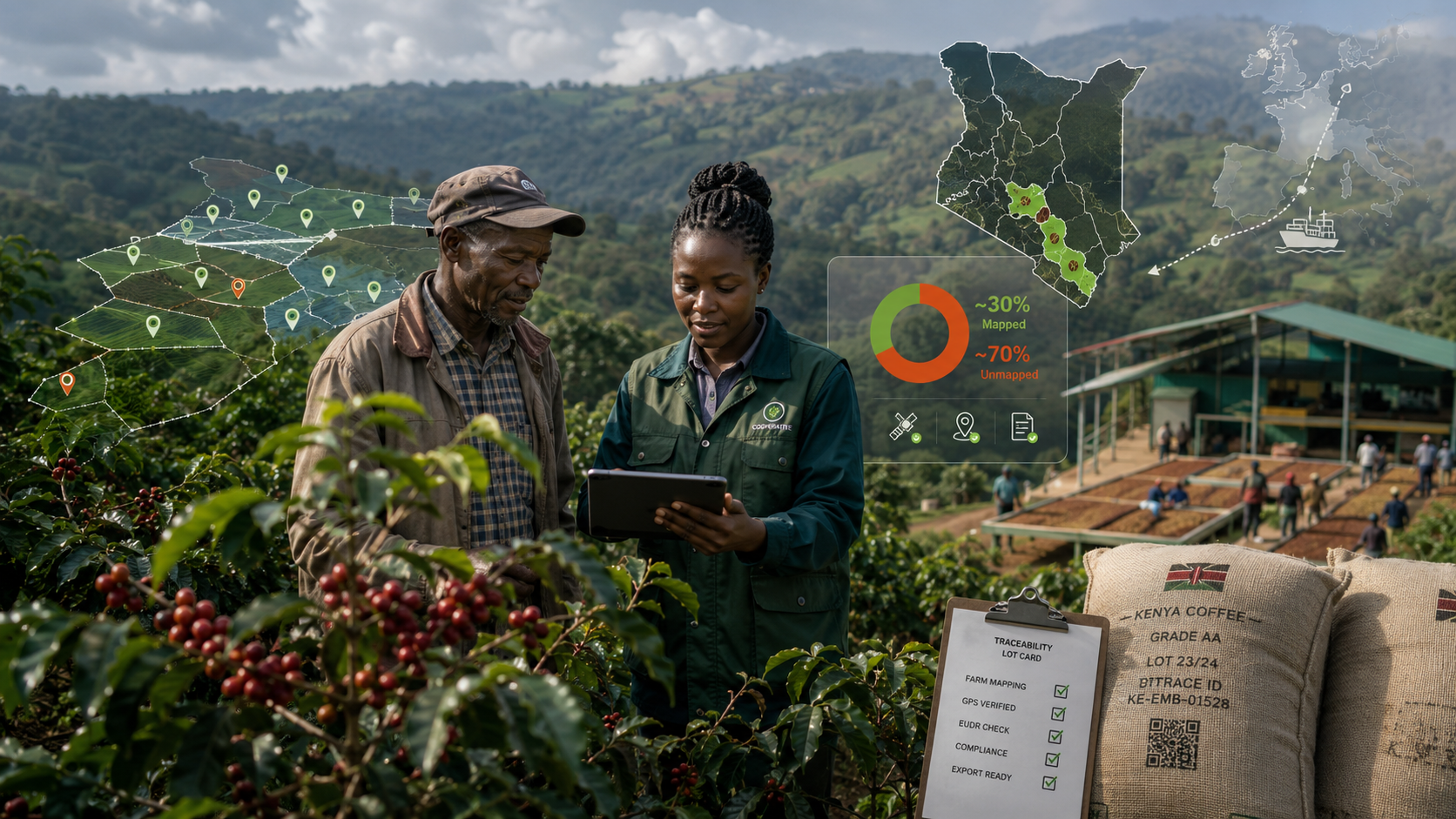
The EUDR compliance challenge for Kenyan coffee has shifted from legal awareness to a delivery architecture problem, requiring urgent, cooperative-level geo-mapping to secure market access.
IPS News reports that Kenya’s coffee smallholders face an existential threat due to significant gaps in EU Deforestation Regulation (EUDR) compliance readiness. Despite the official EU implementation delay, the sector remains underprepared, with only 30% of national coffee farms currently geo-mapped. This creates a high-stakes environment where data-heavy traceability requirements threaten to exclude thousands of small-scale farmers from the EU market.
30%
National coffee farms geo-mapped
32,688 ha
Mapped coffee area out of 109,384 total
30 Dec 2026
EUDR deadline for large operators
70%
Smallholder share of total coffee production
The transition to EUDR compliance is not merely a regulatory hurdle but a fundamental shift in how Kenyan coffee is traded.
Strategic importance
Failure to address the mapping deficit creates significant operational and commercial vulnerabilities.
Long-form analysis
Individual farmers cannot carry the weight of EUDR compliance alone; the burden falls on the cooperative and factory catchment level. The practical unit of execution must be the cooperative, which serves as the primary aggregator for smallholder production.
To succeed, cooperatives must move beyond simple registration to active data governance. This includes cleaning member registers, deduplicating records, and ensuring that farm geolocation data is collected in a standard, interoperable format.
While the European Commission has postponed the main obligations to 30 December 2026 for large operators and 30 June 2027 for small operators, this is an execution window, not a stand-down period. The core requirement—that coffee must be deforestation-free and supported by due diligence—remains unchanged.
Exporters and cooperatives should treat the upcoming crop cycle as the primary compliance-conversion phase. Relying on the delay to postpone action will likely lead to a last-minute bottleneck that the current infrastructure is not equipped to handle.
The current situation requires a move from generic sensitization to a measurable, sprint-based approach. Donors and government agencies should prioritize funding that is directly tied to KPIs such as mapped hectares and verified cooperative registers.
By focusing on a repeatable sprint model, Kenya can protect its smallholder base and maintain its competitive position in the EU market, ensuring that compliance is viewed as a value-add rather than a barrier to trade.