
KEY TAKEAWAY
Kenya must transition from reactive shipping to a proactive, data-driven quality and MRL compliance model to halt market share erosion in the UK and Netherlands.
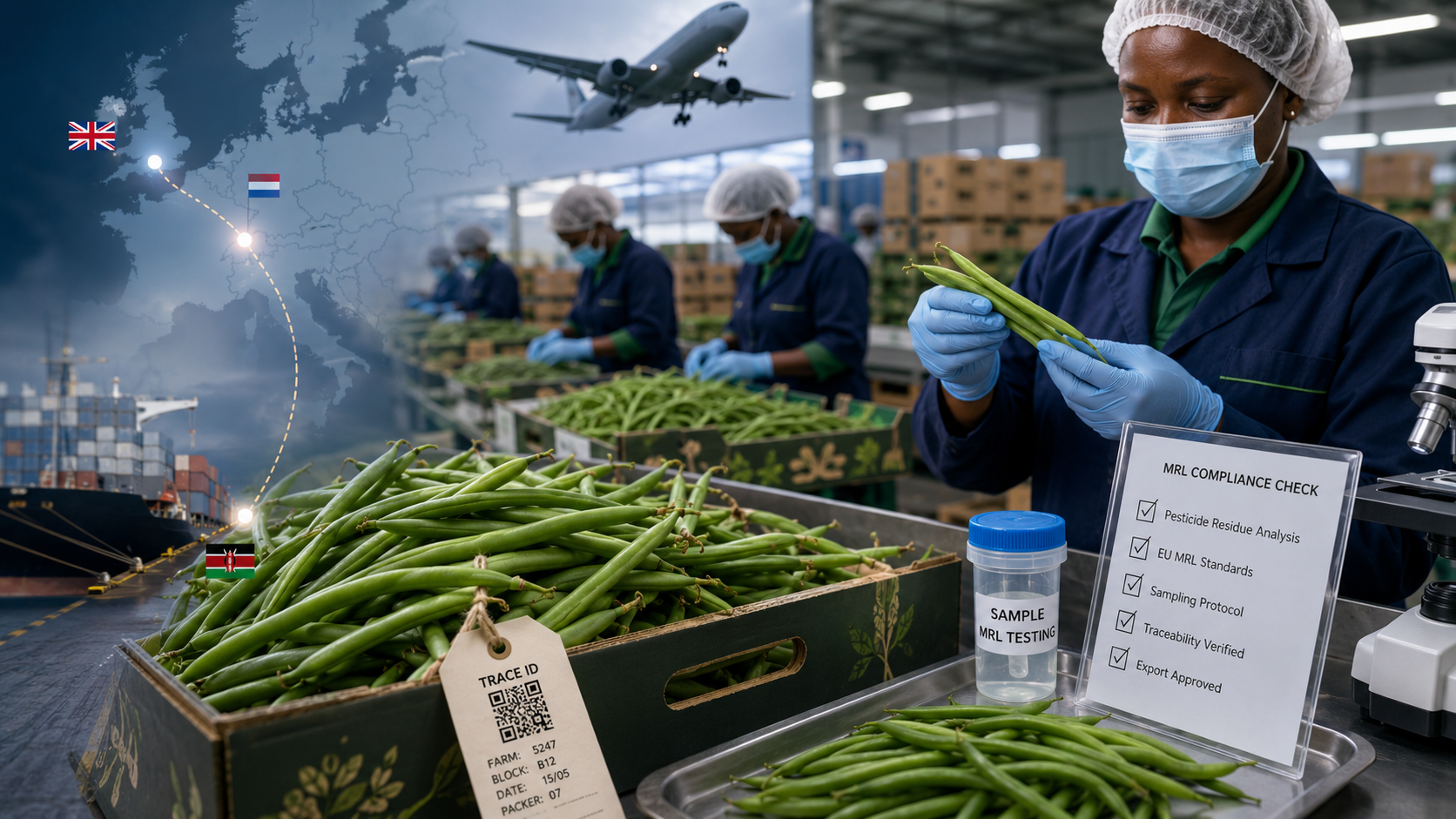
Kenya must transition from reactive shipping to a proactive, data-driven quality and MRL compliance model to halt market share erosion in the UK and Netherlands.
CBI Netherlands has issued a stark warning regarding Kenya’s fresh green-bean exports, highlighting a significant decline in competitiveness across European markets. Persistent quality issues and MRL non-compliance are driving buyers toward alternative origins like Egypt and Rwanda. This shift represents a fundamental challenge to Kenya’s historical dominance in the sector.
18%
Annual decline in Kenyan green-bean volume in the Netherlands
28
Kenyan green-bean consignments failing MRL compliance in 2024
10%
Mandatory EU inspection rate for Kenyan green-bean imports
27,000t
Total UK green-bean imports in 2024, down from 43,000t in 2020
Understanding the shift in buyer preference and regional demand.
Why it matters
Key vulnerabilities currently threatening export stability.
Long-form analysis
The UK remains Kenya's largest market, yet the total demand pool has contracted significantly. With volumes dropping from 43,000 tonnes to 27,000 tonnes over four years, exporters can no longer rely on volume growth to mask underlying issues. The competitive pressure from Egypt, which is growing at 11% annually, signals that buyers are actively reallocating to more reliable origins.
The situation in the Netherlands is even more critical. As a strategic re-export hub, the Dutch market is highly sensitive to quality. The 18% annual decline in Kenyan volumes is explicitly linked to quality failures, which threaten Kenya’s reputation across the entire European distribution network.
Compliance with EU Regulation (EC) No 396/2005 is no longer a routine administrative task but a board-level imperative. With 28 consignments failing MRL tests in 2024, Kenya is under intense scrutiny. The mandatory 10% inspection rate under Regulation (EU) 2019/1793 adds significant cost and risk to every shipment.
Exporters must move beyond final-product testing toward active-ingredient control at the farm level. Retailer private standards often exceed EU legal limits, meaning that 'legal' compliance is often insufficient for premium market access.
The current crisis requires a shift from a sales-led approach to a quality-transformation model. This involves root-cause diagnosis of defect points and rigorous enforcement of packhouse SOPs. By quantifying the defect and failure points, exporters can rebuild the trust necessary to recover market share.
Success in the next 90 to 180 days will be defined by the ability to provide verifiable evidence of compliance. Exporters who prioritize cold-chain management, traceability, and strict adherence to pre-harvest intervals will be the ones to secure their future in the European market.
TFN provides the diagnostic tools and frameworks necessary to navigate these complex compliance challenges.