
KTDA’s Reduced 2024/25 Tea Bonus Shows Why Tea Factories Need FX-Sensitive
1/2
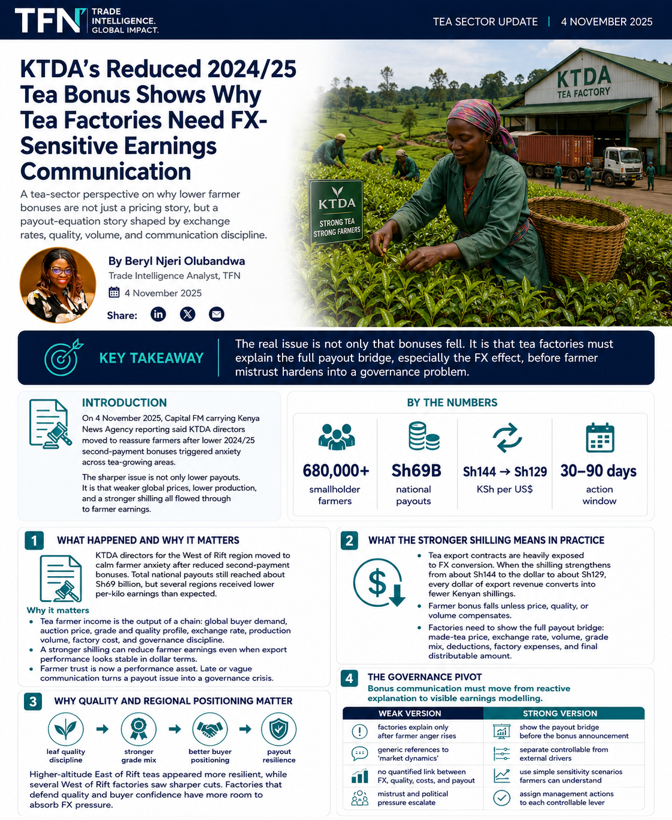
On 4 November 2025, Capital FM, carrying Kenya News Agency reporting, said Kenya Tea Development Agency directors in the West of Rift region moved to reassure farmers after lower 2024/25 second-payment bonuses triggered anxiety across tea-growing areas. KTDA Holdings Vice-Chairman Omweno Ombasa attributed the weaker payout to global market dynamics and policy shifts that the agency said were outside its direct control. Despite the decline, KTDA said total national payouts to more than 680,000 smallholder tea farmers reached about Sh69 billion, the second-highest payout in its history.
The operational point is sharper than the headline. This is not only a farmer-relations story; it is a margin-transmission story. Farmers saw lower shilling earnings because three forces moved together: weaker global tea prices, lower green-leaf production, and a stronger Kenyan shilling against the US dollar. Earlier sector explanations put the exchange-rate movement at roughly Sh144 to the dollar in 2024 versus about Sh129 in 2025. Even where international prices were stable, fewer shillings were realized on conversion. That means currency exposure, not price alone, moved farmer earnings.
The commercial implication for factories and cooperatives is direct: bonus communication must become more analytical, more transparent, and more forward-looking. Tea factories cannot wait for farmer anger before explaining how made-tea prices, exchange rates, grade mix, volumes, factory costs, and auction rules flow into farmer payments. TFN should convert this event into a Tea Earnings & FX Sensitivity Model that helps factories, cooperatives, directors, farmer associations, and policy stakeholders explain bonus movements before mistrust hardens.
Structured Output
1) What happened and why it matters
KTDA directors for the West of Rift region moved to calm farmer anxiety after reduced second-payment bonuses for the 2024/25 financial year. The agency said total payouts to farmers still reached about Sh69 billion nationally, but farmers in several regions received lower per-kilo earnings than expected.
The explanation given combined global price pressure, exchange-rate effects, reduced production, and policy changes affecting tea sales. Supporting sector coverage also pointed to regional variation: higher-altitude East of Rift teas, especially Nyeri and Kirinyaga, held up better, while parts of the West of Rift such as Kericho, Bomet, Kisii and Nyamira saw sharper cuts.
Why it matters (so what)
• Tea farmer income is not determined by one variable. It is the output of a chain: global buyer demand, auction price, grade and quality profile, exchange rate, production volume, factory cost, financing cost, and governance discipline.
• A stronger shilling can reduce farmer earnings even when export performance looks stable in dollar terms. This is the part many farmers will not intuitively accept unless factories explain the conversion logic clearly.
• Farmer trust is now a performance asset. If factories communicate late or vaguely, the payout issue becomes a governance crisis, not only a market-cycle problem.
2) What the stronger shilling means in practice
Tea export contracts and auction transactions are heavily exposed to foreign-currency conversion. When the shilling strengthens from about Sh144 to the dollar to about Sh129, every dollar of export revenue converts into fewer Kenyan shillings. For smallholder farmers paid in shillings, that can depress final earnings even before quality and volume differences are considered.
This is why the weak explanation is ‘prices were bad.’ The stronger explanation is ‘the payout equation changed.’ Factories should show farmers the full bridge from made-tea price to farmer bonus: dollar price, exchange rate, volume, grade mix, deductions, factory expenses, reserve-price effects, and final distributable amount.
3) Why quality and regional positioning matter
The bonus outcome also showed the importance of quality and regional value positioning. Higher-altitude East of Rift teas appeared more resilient, while some West of Rift factories experienced larger declines. This creates a strategic lesson: factory payout resilience is partly built before the auction, through leaf quality discipline, plucking standards, factory processing, grade profile, buyer relationships, and market positioning.
Factories that can defend per-kilo value through quality consistency and buyer confidence will have more room to absorb exchange-rate pressure. Factories that rely only on volume and generic auction exposure will remain more vulnerable when prices soften or the shilling strengthens.
4) The governance pivot: bonus communication must move from explanation to modelling
Most bonus communication is reactive. Farmers complain, directors explain, and political pressure escalates. That model is weak because it treats farmer communication as public relations after the damage is done.
The strong version is an earnings-visibility model: every factory should be able to show what changed, how much it changed, and what management will do about it. This should include a simple sensitivity table: if the exchange rate moves by Sh5, if made-tea price drops by Sh20 per kilo, if production falls by 10 percent, and if grade mix deteriorates, what happens to the farmer payout?
5) What good looks like over the next 30 to 90 days
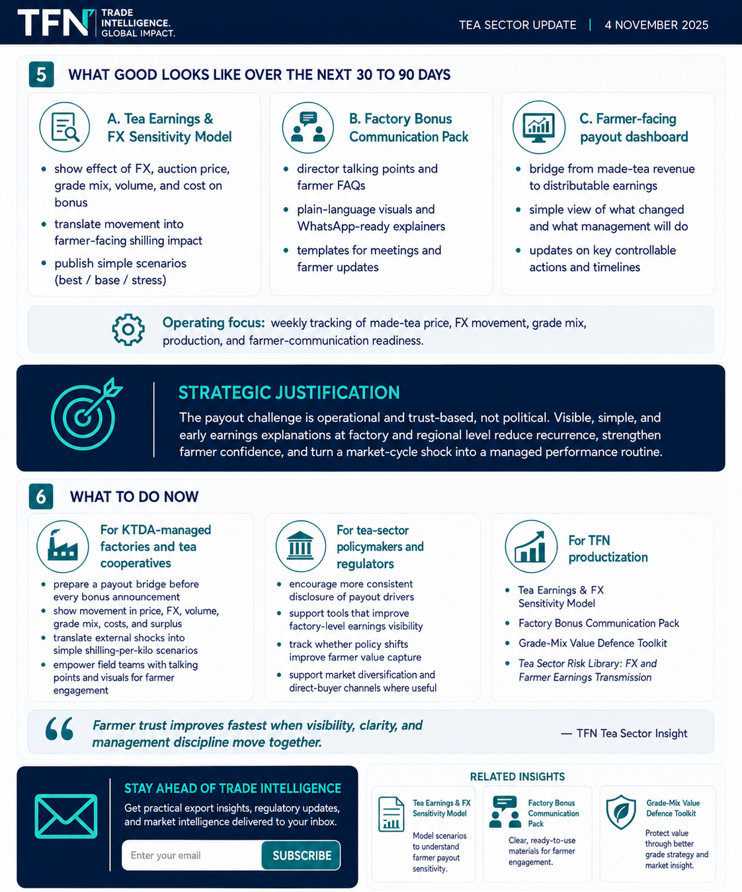
• A Tea Earnings & FX Sensitivity Model showing how exchange-rate movement, auction price, grade mix, production volume, and factory cost affect farmer bonuses.
• A Factory Bonus Communication Pack that directors can use in farmer meetings, including plain-language explanations, data visuals, and Q&A responses.
• A Grade-Mix Value Defence Toolkit that helps factories connect leaf quality, processing discipline, buyer preference, and final payout resilience.
• A farmer-facing dashboard showing the payout bridge from made-tea revenue to distributable farmer earnings.
Strategic Justification
This is a medium-priority tea-sector signal because it reveals a structural weakness in how smallholder tea earnings are explained. The issue is not only that bonuses fell. The issue is that many farmers do not have a clear visibility chain showing how global market prices, FX conversion, policy shifts, reserve-price changes, production volumes, and factory-level performance translate into the number on their payslip.
For Kenya’s tea sector, the defensive move is not to argue with farmers after the payout. The defensive move is to professionalize earnings communication before the payout. Factories and cooperatives need to explain the margin bridge, quantify the FX exposure, and show the actions being taken to protect per-kilo value.
For TFN, this entry should become a reusable tea-sector product. The market need is obvious: factories, cooperatives, farmer associations, buyers, donors, and public agencies all need a clearer way to explain income volatility and value-chain transmission. A Tea Earnings & FX Sensitivity Model would turn farmer anxiety into a structured discussion about what moved, why it moved, and what can be controlled.
Call to Action / Integration Tip (how to use this immediately)
For KTDA-managed factories and tea cooperatives
• Prepare a payout bridge before every bonus announcement. Show farmers the movement in global price, exchange rate, production volume, grade mix, costs, deductions, and final distributable surplus.
• Separate controllable and non-controllable drivers. FX and global prices may be external; quality, plucking discipline, factory efficiency, buyer targeting, cost control, and communication are controllable.
• Use plain-language farmer communication. Do not say ‘global market dynamics’ and stop there. Translate the issue into shilling impact per kilo and show the scenarios.
For tea-sector policymakers and regulators
• Require more consistent disclosure of factory-level payout drivers so farmers can compare performance fairly.
• Support market diversification and direct-buyer channels where these improve price resilience and reduce overdependence on generic auction exposure.
• Track whether policy shifts, including auction rules and direct-sale restrictions, are improving farmer value or only changing where value is captured.
For TFN productization
• Build the Tea Earnings & FX Sensitivity Model as a reusable spreadsheet and dashboard tool for factories, cooperatives, farmer associations, and donor programs.
• Create a Factory Bonus Communication Pack with director talking points, farmer FAQs, data visuals, and WhatsApp-ready explainer messages.
• Add this case to the Tea Sector Risk Library under ‘FX and Farmer Earnings Transmission.’
• Develop a Grade-Mix Value Defence Toolkit linking quality discipline, processing standards, buyer segmentation, and payout resilience.
McKinsey playbook lens
Treat this as a value-driver bridge problem, not a public-relations problem. The winning model decomposes farmer payout into its drivers, quantifies sensitivity, separates controllable from external variables, and assigns management actions to each controllable lever. The metric is not whether farmers were reassured for one news cycle; it is whether they understand the payout logic and trust the factory’s response before the next bonus cycle.
CTA: Chat with Trade Facilitation in a Nutshell
This is exactly where TFN can add practical value to the tea sector. Reduced farmer bonuses are not solved by generic explanations. They require a structured earnings model, clear farmer-facing communication, and a factory-level action plan that links quality, market positioning, FX exposure, and payout resilience.
For tea factories, cooperatives, farmer associations, buyers, development programs, and public agencies working on tea-sector competitiveness, TFN can support with a practical tea earnings and communication package.
How TFN helps solve this class of problem
• Detect: identify early warning signals from exchange-rate movements, auction-price trends, buyer demand, carry-over stocks, and factory-level production data.
• Diagnose: classify whether the earnings pressure is mainly FX-driven, price-driven, quality-driven, production-driven, cost-driven, or policy-driven.
• Decide: match the problem to the right response, including farmer communication, quality improvement, buyer segmentation, cost-control action, market diversification, or policy engagement.
• Deploy: convert the response into models, templates, dashboards, meeting packs, and training tools that factories and institutions can use immediately.
Work with TFN
If your tea factory, cooperative, buyer program, farmer association, donor project, or policy institution needs to explain payout volatility, protect farmer trust, or strengthen tea-sector competitiveness, use this case as the trigger to build a standing Tea Earnings & FX Sensitivity Model before the next bonus cycle. Visit Trade Facilitation in a Nutshell to request a tea earnings diagnostic, factory bonus communication pack, or grade-mix value defence toolkit.
Source Note
This document was structured using the updated TFN Content Engine article format reflected in Entry 136 and Entry 137: title, date, geography, classification, source links, executive summary, structured output, strategic justification, call to action/integration tip, TFN CTA, source note, and byline. The factual basis is the Capital FM / Kenya News Agency report dated 4 November 2025, with supporting coverage from AllAfrica, Business Daily, The Star and Maudhui House.
TFN access point: Trade Facilitation in a Nutshell
By Beryl Njeri Olubandwa
Prepared by Beryl Njeri Olubandwa