
KEY TAKEAWAY
While record cargo volumes validate the Port of Mombasa as a regional trade anchor, persistent congestion indicates that throughput growth is currently outpacing essential capacity and operational efficiency.
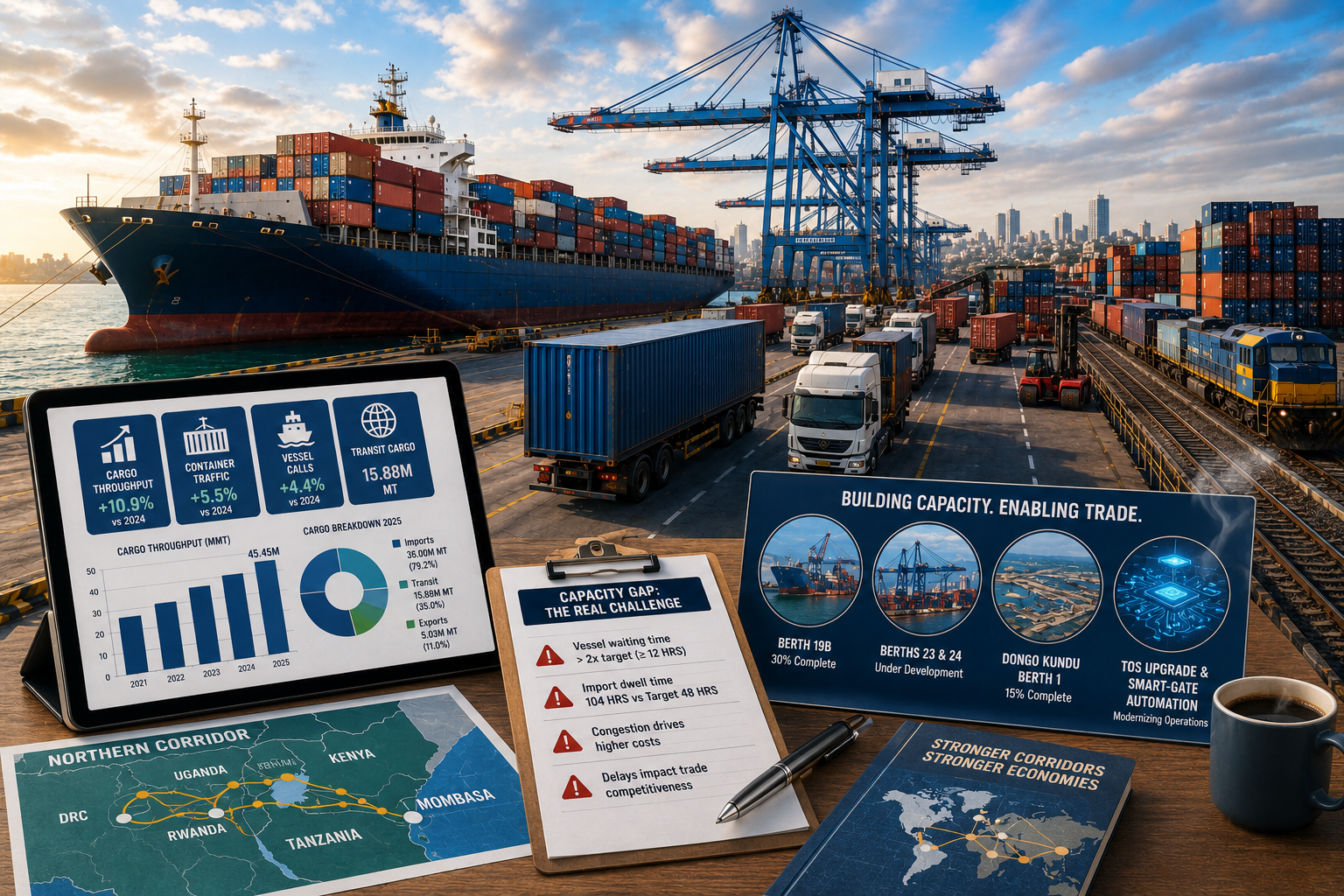
While record cargo volumes validate the Port of Mombasa as a regional trade anchor, persistent congestion indicates that throughput growth is currently outpacing essential capacity and operational efficiency.
The Kenya Ports Authority reported a record 45.45 million metric tonnes of cargo throughput in 2025, marking a significant increase from the previous year. However, this headline growth masks operational stresses, including vessel waiting times and container dwell times that consistently exceed target benchmarks. For regional stakeholders, this signals that Mombasa is operating near the edge of its capacity, turning infrastructure projects into critical success factors rather than background developments.
45.45M tonnes
2025 Total Cargo Throughput
5.5%
Annual TEU Growth
104 hours
Average Import Dwell Time
1,955
Total Vessel Calls in 2025
The surge in cargo confirms Mombasa's role as the primary gateway for East and Central Africa.
Strategic drivers
Unmanaged growth threatens to turn a competitive advantage into a cost burden for shippers.
Long-form analysis
The 2025 performance data presents a dual reality: Mombasa is successfully attracting record volumes, yet the port's internal systems are struggling to process this influx without friction. While transit cargo growth confirms the port's central role in regional supply chains, the modest growth in exports compared to imports suggests an imbalance in flow management.
This imbalance places immense pressure on yard capacity and gate automation. Without synchronized improvements in inland evacuation and customs coordination, the port risks becoming a bottleneck that stifles the very growth it seeks to facilitate.
Port congestion is fundamentally a trade facilitation challenge that extends far beyond the terminal gates. For exporters of perishables, such as flowers and fresh produce, delays at the port translate directly into lost market value and compromised product quality.
Reliability is the new currency of market access. Buyers in international markets assess suppliers not just on price, but on the predictability of their logistics chains. Persistent delays at Mombasa weaken the competitive position of East African producers.
Over the next three months, the focus must shift from celebrating volume records to executing on capacity-unlocking milestones. This includes tracking the progress of Berth 23 and 24 alongside the implementation of enhanced Terminal Operating Systems.
Stakeholders should move toward a shared performance dashboard that links cargo throughput with real-time congestion indicators. By fostering transparency, the port can transform from a reactive environment into a proactive, data-driven corridor platform.
TFN provides the intelligence layer necessary to turn complex port data into actionable logistics strategies.